Why I built it
Curiosity. Public AI assistants send every prompt to someone else's servers, and I wanted to understand what it really takes to run the whole chain myself, from the GPU to the chat interface, without exposing a single service to the internet. So I built it, to test, practise and learn.
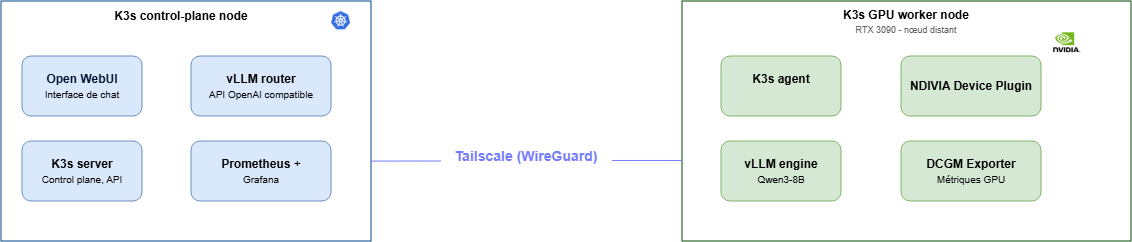
Architecture
What I built
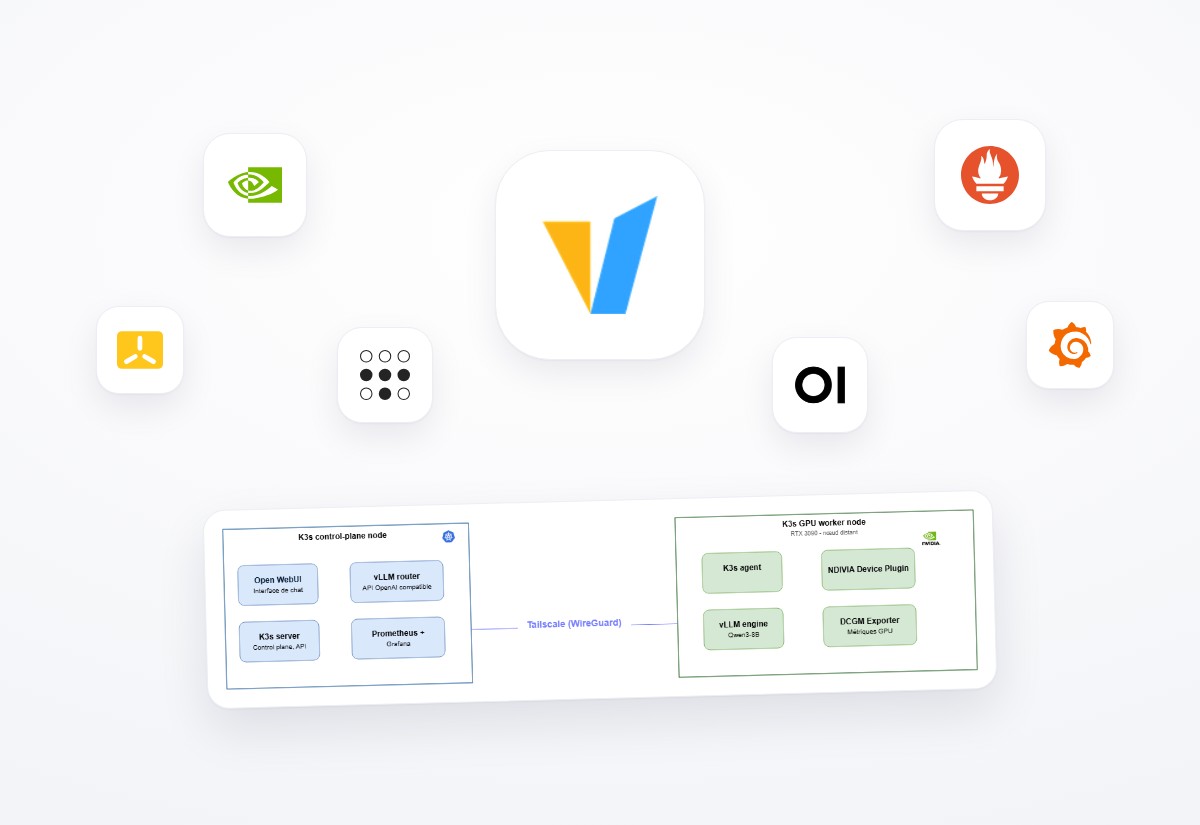
- Built a K3s cluster with a remote NVIDIA RTX 3090 worker node, joined over Tailscale so that no service is exposed to the internet.
- Deployed vLLM with Helm to serve open models, such as Qwen3-8B, through an OpenAI-compatible API.
- Deployed Open WebUI as the chat and administration interface for the models.
- Set up observability with Prometheus, Grafana and the NVIDIA DCGM exporter, covering Kubernetes, the GPU and vLLM.
- Created Grafana dashboards to follow GPU performance, cluster health and model serving.
- Wrote a Python MCP server that brings Kubernetes administration, GPU monitoring and vLLM metrics into Visual Studio Code.
Outcome
A private platform that works end to end. Open models run on the remote GPU, the chat interface is only reachable inside my Tailscale network, and dashboards show the GPU, the cluster and the model serving in real time. I documented the whole build in an article on Grace Your Brain.